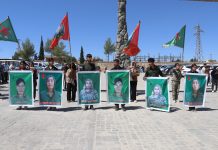
In tribute to the spirit of courage and sacrifice, and in loyalty to the purity of the blood of the women martyrs who inscribed epics of dignity and honour upon the soil of steadfast Kobanê, these lines are dedicated to immortalizing the noble legacy and legendary stand of the heroic woman fighter and martyr, Arîn Mîrkan. That fearless determination became a global symbol of a people’s uprising that refused to be broken, and of the resolve of a free woman who shook the thrones of darkness.
Throughout the history of peoples and their liberation struggles for emancipation and dignity, exceptional moments emerge—moments forged through immense sacrifices. Names rise in their skies, refusing to bow before the storms of injustice and tyranny and refusing to pass unnoticed through the pages of time. Among these immortal names, engraved in the conscience of humanity in letters of light and fire, stands the name of the heroic martyr Arîn Mîrkan (Dilara Keng). This courageous fighter became inseparably associated with the steadfast city of Kobanê, transforming from a devoted daughter of this generous land into a global symbol of women’s resistance and sacrifice, and an ever-burning flame illuminating the paths of freedom for all those striving to break the chains of oppression. To speak of Arîn is not merely to recount the life of a revolutionary; it is to explore the philosophy of resistance that took root deep within the consciousness of an entire people.
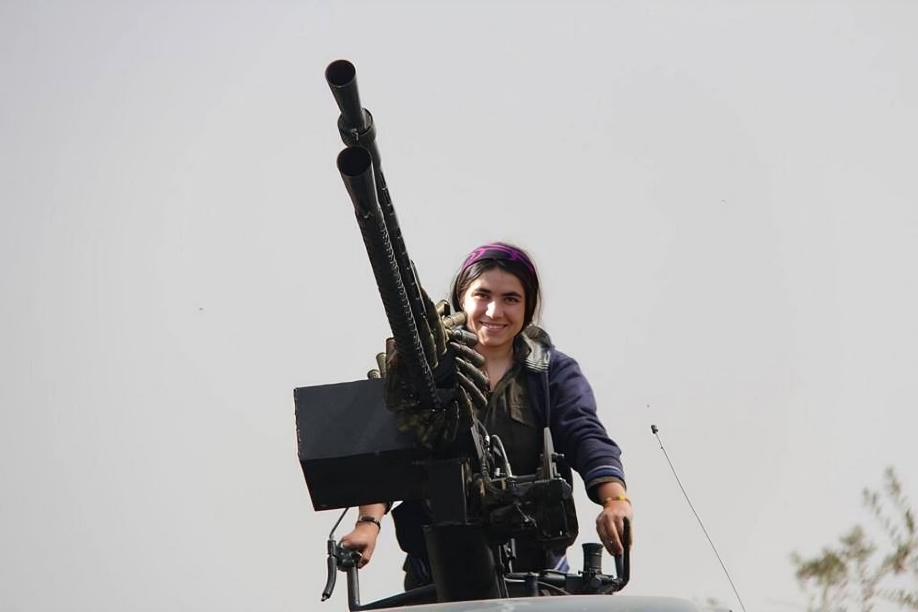
Arîn grew up in a mountainous environment imbued with the values of dignity and love for the land, which led her to join the liberation movement at an early age, driven by her belief in the cause of her people and the justice of women’s struggle. When the city of Kobanê came under a brutal and savage attack by the terrorist organisation ISIS in 2014, which sought to erase the city’s identity and break its will, Arîn stood at the forefront among the Women’s Protection Units (YPJ), defending the honour of her land and its people with a courageous heart and unyielding determination.
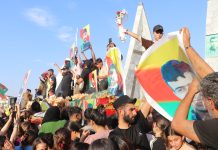
This legendary act of sacrifice was not an end; rather, it was the brilliant spark that ignited a massive popular uprising that shook the foundations of the region and the world. As soon as news of her martyrdom spread, the people of Kobanê rose up in all their diversity—elders, youth, and women—declaring their complete solidarity with the fighters in the trenches. The city’s streets were transformed into arenas of overwhelming anger and steadfast popular resistance, as residents rose to defend every neighbourhood and every home, drawing strength and determination from Arîn’s spirit. This uprising was not confined to Kobanê; it spread like wildfire across all parts of Kurdistan. Thousands headed towards the borders to break the siege imposed on the city, while massive demonstrations erupted in European and other world capitals. The Kobanê cause thus became an issue of global public concern, embodying the unity of a people around the sacrifices of its martyrs, who became shields protecting human values.
Remembering the martyr Arîn Mîrkan today is not merely a passing emotional reflection on moments in history; it is an ongoing revival of the noble human values she defended and for which she gave her life. Through her act of sacrifice, she proved that the will of free peoples cannot be defeated by the machinery of destruction, and that women are capable of leading the most difficult battles and changing political and military realities on the ground. The day of her martyrdom became a symbol of rising up and revolt, breathing new life into the veins of resistance, making Arîn a school of thought and struggle from which the meaning of sacrifice and selflessness in the face of tyranny continues to be drawn.
In conclusion, the martyr Arîn Mîrkan will remain alive in the hearts of free people and a living testament to the fact that Kobanê was not merely a geographical city on a map, but an impregnable fortress of steadfastness whose strength and power were drawn from the blood of its noble women martyrs. The memorials and statues that commemorate her image today in public squares are but a physical embodiment of her spiritual immortality in the memory of successive generations. The anniversary of her martyrdom will remain a national and humanitarian occasion on which renewed pledges of loyalty are made and the commitment to continue along the same path is reaffirmed. Arîn will remain, always and forever, a symbol of the free woman who gave her life so that dawn might rise and the homeland might live proudly in dignity and unblemished freedom.